Archive

Tag Archives: Gay

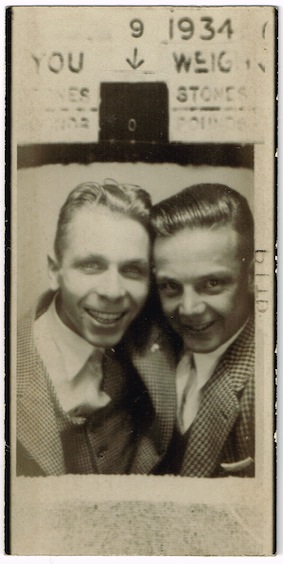
photoboothLovelyMenPhotoWeigh01

Our young man on the right, in 1934. Love those almost identical suits and those hairstyles!

Photoweigh photobooth photos are rare. Between the 1930s and 1970s when the last of these booths disappeared, there appears to have been only a handful scattered across the UK, Germany and France. Although a business called the American Automatic Photoweigh Company Inc. was registered in America, there does not appear to have been any booths operating there.

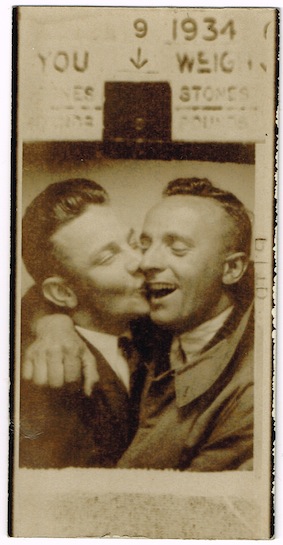
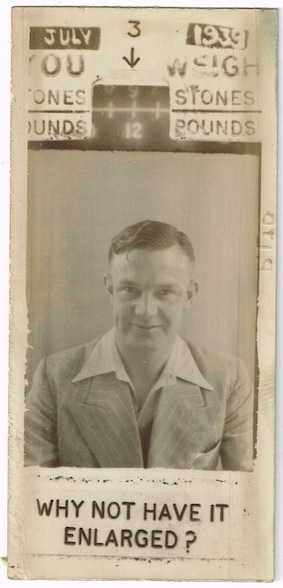
These English photos from 1934 and 1939, above and below, are even rarer than typical, holiday-souvenir Photoweigh images, as they show the same young man in two close poses with his male friends. There are many photos for sale online which purport to show gay or lesbian lovers. In most instances it is decidedly unclear as to whether the subjects are just pals or in closer relationships. However in this instance, I think it is safe to say the men pictured here are more than just friends.
photoboothLovelyMenPhotoWeigh02

Again in 1934 but now on the left, in a joyful embrace.

At a time when homosexuality was still criminalised, taking affectionate same sex snapshots to a commercial printer, posed risks to what would have needed to be clandestine relationships. Without access to your own darkroom, photobooths were the only way to commemorate a gay relationship in private and with confidence. Photobooths created images without a tell tale negative or in the case of some Photoweigh machines where a paper negative was supplied with the finished positive, leaving no record in the machine.

Despite the happy and loving nature of these photos, there is a heartbreaking poignancy to them, given the prejudice and suffering endured by the same sex community at the time. The young man who is pictured in all three photos, looks a jolly type. I hope that translated into a fulfilling and happy life despite the obstacles he would have had to face.

You can read more about the history of this type of photobooth here, and see more Photoweigh images here.
photoboothLovelyMenPhotoWeigh03

Five years later, a solo portrait.

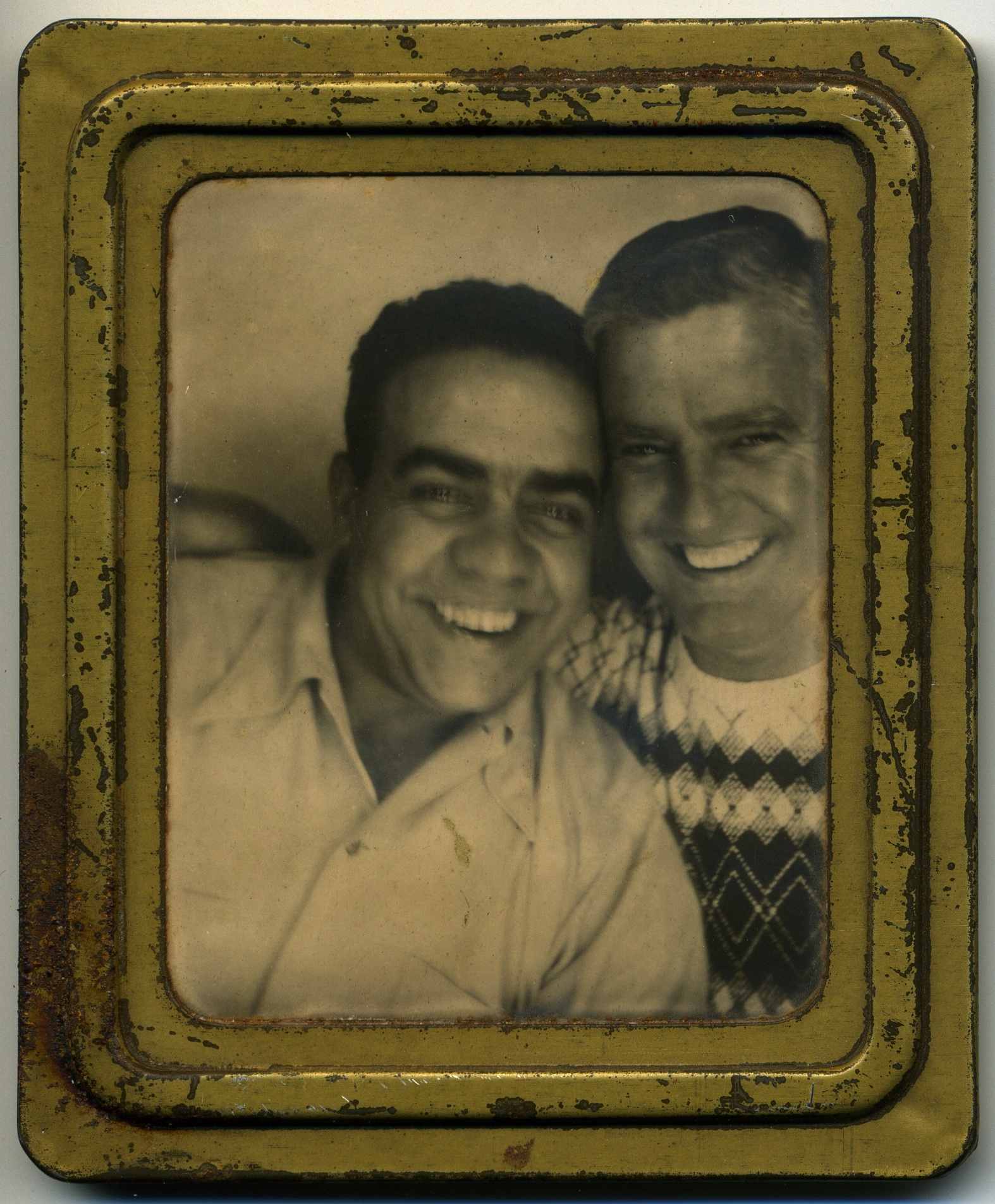
This fabulous photomatic booth photo of what appears to me to be a father and son, was listed as a “gay interest” item in its online advertisement.  I find this type of description interesting and confusing. If any photo has two men in it, looking happy or like they may be good friends, online sellers love to throw in that tag. Similarly the “lesbian interest” tag is often used if two women are depicted. Why do we never see “straight interest” listings? Do gay/lesbian people search for the “gay/lesbian interest” tag? If they do are they horribly disappointed with what they find?

Scott Davis from dcphotoartist has looked at this issue in an eloquent article, some of which is quoted below. One of Scott’s collecting interests is cabinet cards of the Victorian Era.

Another marketing trend I find a bit odd is the whole “gay interest” tag in the image description. On one level, I get it – the seller is trying to reach out to an under-appreciated market. On the other hand, I question if the people using that tag line understand the “gay interest” thing at all. Two men or two women posing together in the Victorian world did not make them a same-sex couple. They could be siblings, co-workers or just friends. 99% of the time we have zero context to go with any image to make an assessment of the relationships captured in the images. There was no public subculture in the 1850s or even in the 1880s that we would today recognize as analogous to the late 20th/early 21st century gay culture, and as such it would not have been recorded photographically. There is certainly an interest in finding proof of ancestry – “see, we DID exist in the 1850s”. Unfortunately, buying in to the “gay interest” marketing of these images is really just being taken for a ride through ignorance and vulnerability. Don’t get me wrong – it’s certainly fun to speculate what might have been going on behind the scenes of these pictures, and what the relationships of the sitters might be to one another. I have one image in my collection that in the right minds implies no end of off-camera highjinks. But it’s still pure speculation. If you see an image marked “gay interest”, buy it only because you actually like the image, not for any marketing baloney designed to separate more of your hard-earned money from you than is fair.

I would argue that these points are equally relevant for many photos up to the 1950s and beyond. In another article Scott continues –

The “Gay Interest” label is a purely 21st century invention for marketing purposes, imposing our sensibility on an image of something that may (and quite probably) have had nothing at all to do with the modern sensibility. It points out a very interesting problem/characteristic of the malleability of truth – there was a “Truth” behind each of those photos, one we can never know because it was unrecorded or became detached from the image. When we come along years later and invent or imagine a story revealed by the image, is it any less real than the story the image intended to tell at the time of its creation? It certainly says more about us in the 21st century and how we interpret these images than it does about the people in them, but in doing so, does it actually help make the images more relevant and meaningful, and continue their survival? 

Please click the links above or here to visit Scott’s blog. He has some fabulous ideas and images to share.