Archive

Vintage Photobooth

photoboothLydieLore 1

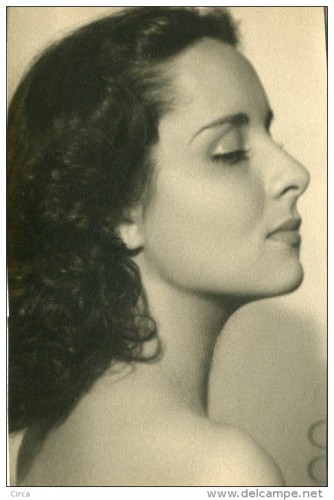
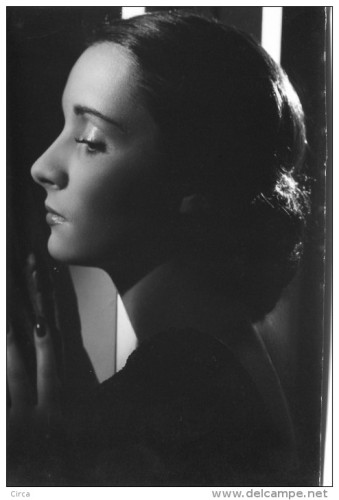
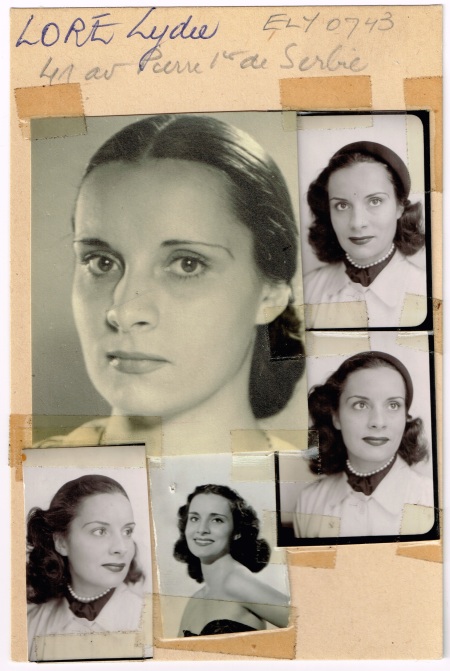
I would like to think that Lydie Lore (or Lydie Loré) had a good career as a stage actress. In an online search however, all the photos I have found of her are linked to the same seller from whom I bought this, and the other file cards from this series.

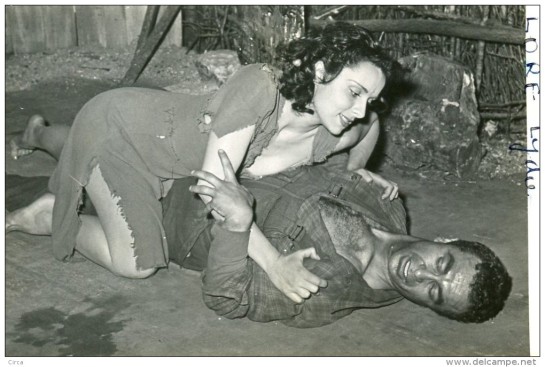
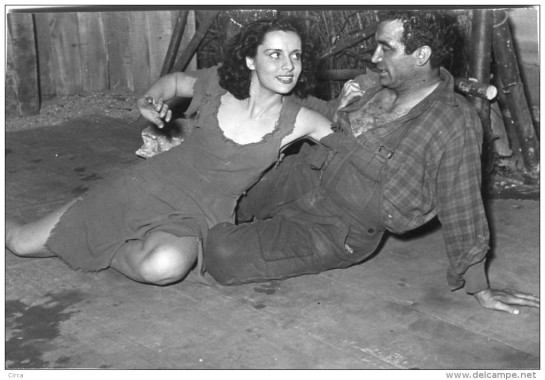
In two of these photos, (which you can see, below), she is pictured on stage with an older man. All of the photos are very professionally realised, so I have assumed that this means she was in professional productions. Unfortunately however, I cannot find any reference to her work, save for one play called La Route du Tabac, in which she performed in 1947. It is likely the two photos with the man are from that production.

So, maybe Lydie was not as successful as I would like to imagine. Like me, she may have had an addiction to getting photo portraits made, but unlike me, she chose to have them taken in a studio, not in a photobooth.

This card has more photos than most of the items in this series. The booth photos are particularly lovely, showing what an attractive, sophisticated and fashionable young woman she was. Her address and phone number are listed in pencil at the top of the card. Unlike some of the other file records from this agency, there are no further details about her listed on the back.

There are some other great photos in this series, so stay tuned to Photobooth Journal for more posts.

930_001 921_001

216_001 136_001

photoboothPinocchio

I have never been much of a fan of Disney animated cartoons, having been much more taken with the Warner Brothers characters Daffy Duck and Bugs Bunny, than the goody two shoes Mickey Mouse and the angry and incomprehensible Donald Duck. However, give me a Disney character in a photobooth and it is all love from me.

Pinocchio is the creation of Italian children’s author Carlo Collodi, whose wooden boy was a lot less likeable than the Disneyfied version. I can find no reference to Disney buying the rights to use the story, so assume that no royalties were paid to the original creator or his descendants. In such circumstances was the Disney empire founded.

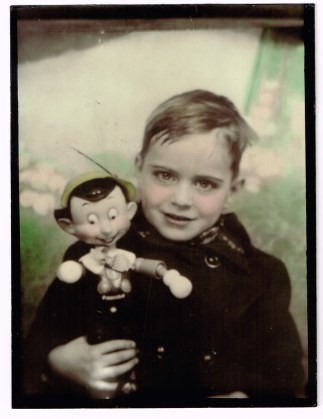
This photo was taken on December 28th in the same year the animated film was released, 1940. Pictured is a very handsome young man clutching his licensed character doll, which given the date of the photo, must have been a prized Christmas gift.

The photo, an enlargement of a  smaller photobooth image, measures 80 x 111 mm. It has been lightly hand coloured, with both the Pinocchio’s and the child’s cheeks highlighted with a lovely rose red.

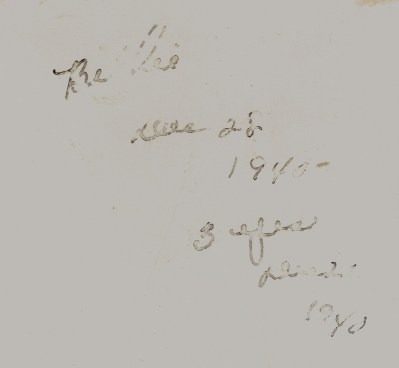
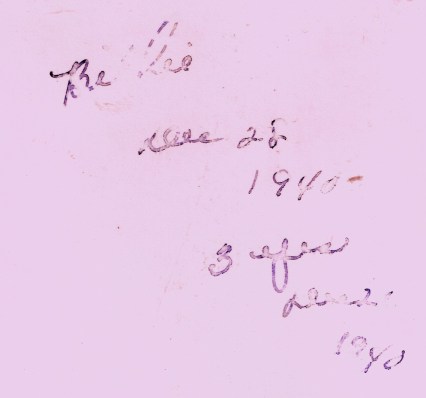
Below is a scan of the back of the photo. Once again I am asking for help to decipher handwriting. Try as I might, I cannot work out what the first word is. I suspect it is either the name of the sitter or of the place where the photo was taken, possibly even the name of a store? I have added two scans with different toning, neither of which are very clear but they are the best results I could get from my aging scanner. The date December 28, 1940 is clear. Below that I think it says 3 years but I cannot make out the following word, nor understand why the year 1940 is written again. Any offers of help are greatly appreciated in the comments section. Thanks!

photoboothPinnochio

photoboothPinnochio 1

photoboothClocheHatsGermany1929

These two happy ladies had their portrait taken in a photobooth, somewhere in Germany, on the 15th of April, 1929. The cloche hats they are wearing were derided as unflattering by contemporary cartoonists and columnists alike. It didn’t stop their popularity!

The cloche was invented in 1908 by milliner Caroline Reboux. They became popular from about 1922 to 1933. Its name is derived from cloche, the French word for bell.

photoboothItalian 4

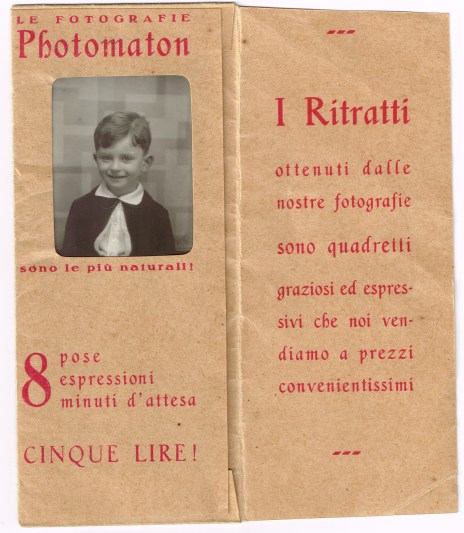
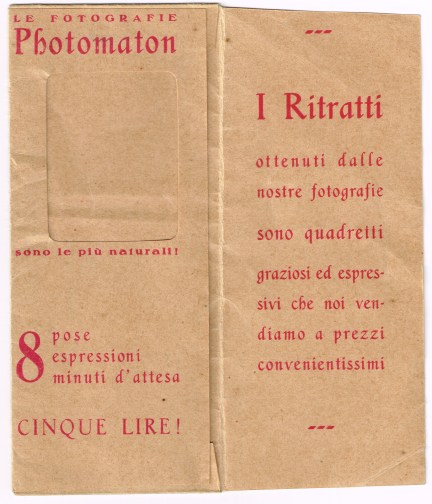
Photomaton photographs are the most natural.

8 poses
8 different expressions
8 minutes waiting
Five lire!

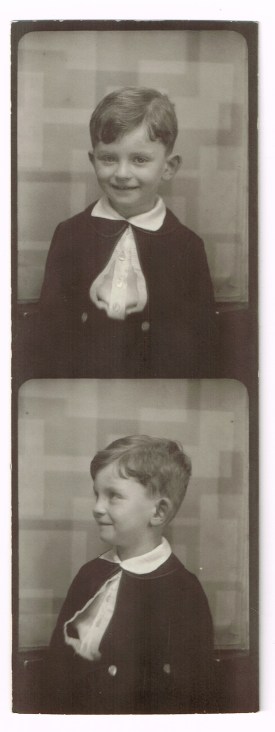
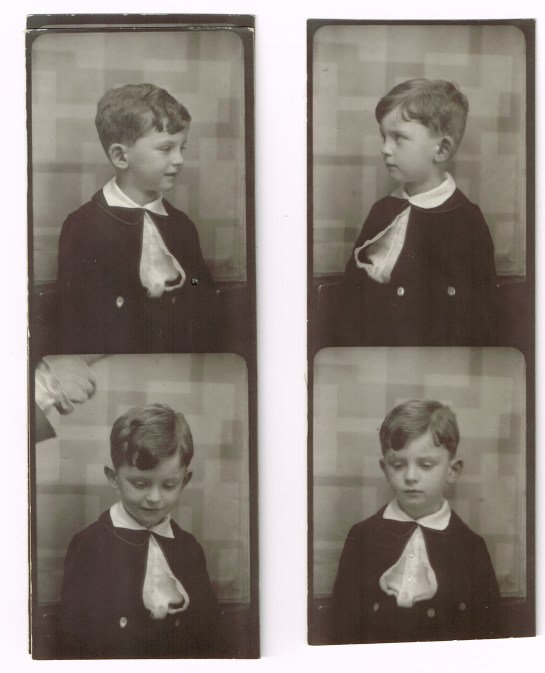
These are the only Italian photobooth photos that I have in my collection. The envelope they came in is very rare. Though I have a number of these from France, I have never seen another one from Italy. There are 6 of the original eight photos in the group. I had thought there were only four, but received a welcome surprise on scanning them, when I notice another two, lightly stuck to the back of another pair.

photoboothItalian 3

The photos show a very handsome young man in a formal collared shirt and tailored jacket. He was obviously having trouble with knowing what to do, as can be seen by the pictures where he is looking down and by the gloved, pointing hand that appears in the bottom left image, below.

photoboothItalian 2

photoboothItalian 1

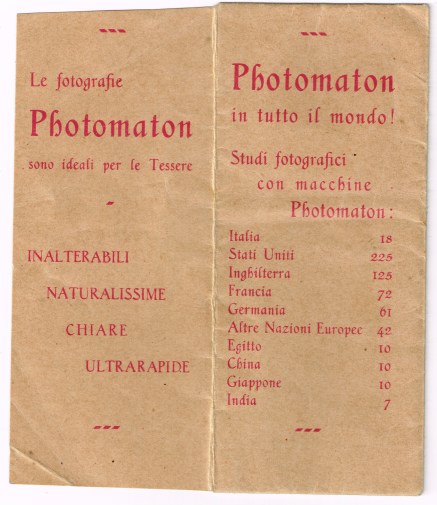
The number of booths in each country is listed on the back of the envelope.

photoboothItalian

photoboothHelen and ChristianFerroType Machine

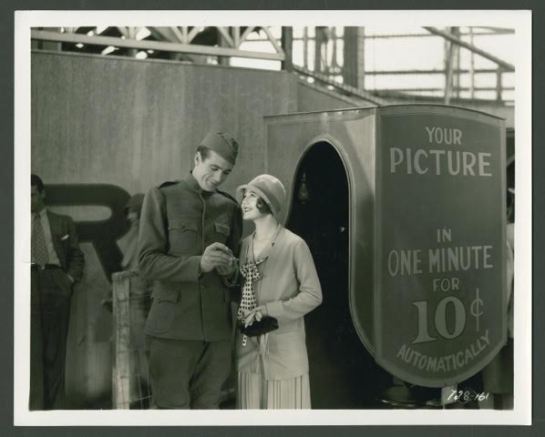
The above film still from the 1928 film The Shopworn Angel, was sent to me by Les Matons, also known as the photobooth artists Hélène Fabre and Christian Bonifas from France.

I was very excited to receive this image, as it shows one of the earlier incarnations of an automatic photo machine. In the late nineteenth and early twentieth centuries, there had been many different attempts to make a reliable automated photo apparatus. However, no one truly succeeded until Anatol Josepho patented his fully automated Photomaton in 1925. By the time this film was made, the above booth was very old fashioned indeed, and quite ready to be consigned to the rubbish tip.

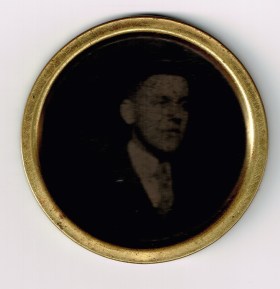
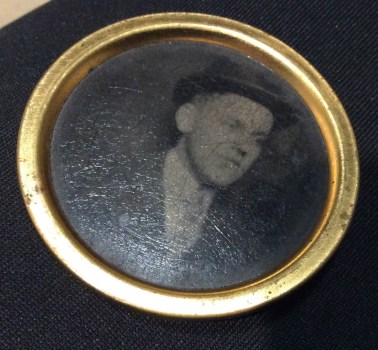
Unlike the type of photobooth pioneered by Josepho, which produce the familiar, paper, photobooth strip, this booth produced a single tintype photo.  Thanks to the impeccable research of Nakki Goranin in her book American Photobooth, I was able to find what I think is a tintype from this type of machine, or from a machine very like this one. (See below) The image did not scan or photograph well, so I included both, in the hope that you will get an idea of what this machine might have produced. This tintype photo measures approximately 45 mm (1 3/4″) in diameter and shows a young man wearing what is possibly a bowler hat. It is hard to be sure as the top part of the crown is obscured. This gentleman is well dressed in shirt and tie and very confident in front of the camera.

While this item doesn’t set my pulse racing, the way early paper-strip photos do, I am very happy to have this part of the photobooth story represented in my collection.

photoboothRoundTintype
photoboothTintypeRound
Postscript – Some trivia that appeals to me about  The Shopworn Angel, is that when it was nearing completion, The Jazz Singer (1927) was released. The excitement of this dawning of a new age of film, was such that it virtually ended silent-film making over night. In order to avoid probable box office failure, last minute dialogue was written for the stars Gary Cooper and Nancy Carroll and the final scenes were duly shot with sound. The last scene was a wedding and the only lines of dialogue spoken are Cooper’s, “I do,” and Carroll’s, “I do.” In addition, Carroll is heard singing the theme song.


photoboothCalPenSueTim

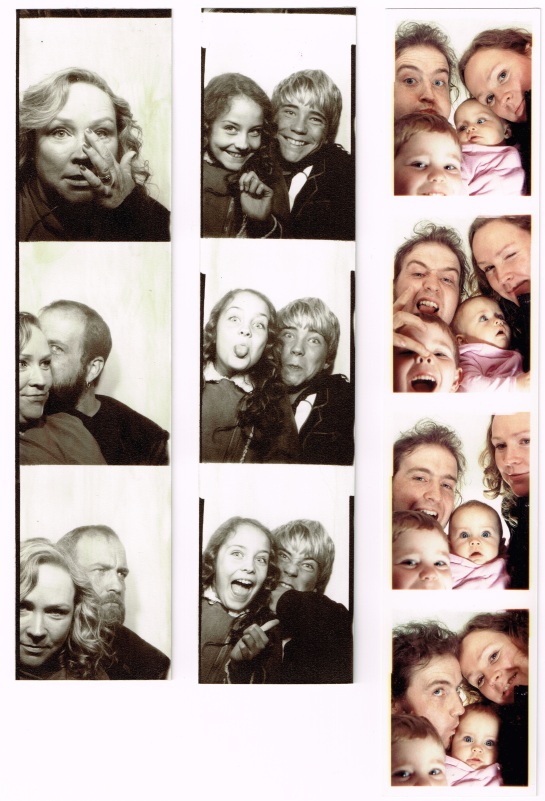
To celebrate the 17th March, I had plans to make my first St Patrick’s Day photobooth strip. Unfortunately my health was such that I was unable to drive as far as the nearest booth site in time, so here instead, are some Irish relatives of mine. Oh, and a pseudo booth strip on a green theme, below.

Happy St Patrick’s Day!
PhotoboothStPaddy'sDay2016photocabine_2

photoboothTedStutz1970

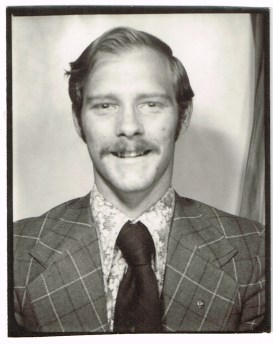
My friend Ted, also known as one of the larrikin lads in an earlier post, Two Drunks In A Photobooth, is now looking more composed and formal for the camera. I haven’t asked Ted about this, but was it really fashionable in the early 1970s, to wear a window-pane, checked suit with a floral shirt? My guess is that Ted was a fashion leader in this combo, and just so far ahead of the game no one else has ever caught on to this eclectic mix!

Love the face fuzz, Ted.

photoboothBensamon

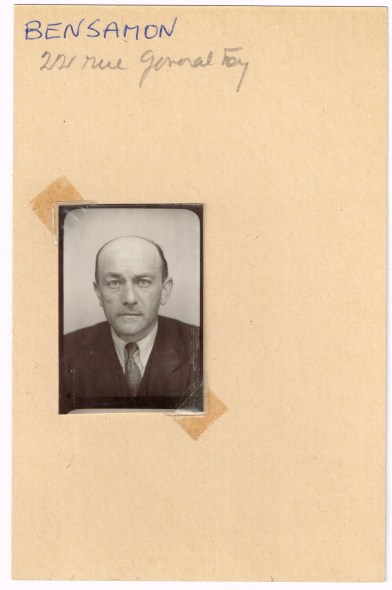
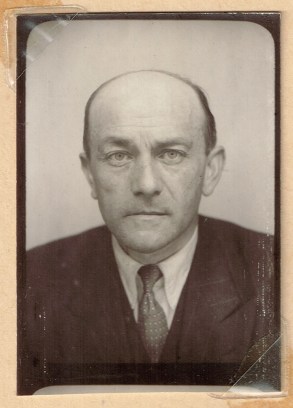
This is another in the series of photobooth photo, file cards from a Parisian acting agency. Each photo attached to the card is of a client who was looking for work in the acting profession in the 1950s or 60s.

Monsieur Bensamon, above, looks to me to be perfect for any role as a valet or butler. Which brings me to a film Murder by Death (1976), which is one of my favourite comedies from childhood. It has an all-star cast which included, bizarrely, author of In Cold Blood and Breakfast at Tiffany’s, Truman Capote.

Maggie Smith and David Niven play an aristocratic couple, Dora and Dick Charleston (See dialogue below) who are invited with a group of other guests, to a spooky house where a murder is subsequently committed. The house of course had a butler. It is an affectionate spoof of the work of numerous crime writers of the era but most particularly of the stories of Agatha Christie.  All this is by way of explaining why I bought the above photo, as the butler in Murder by Death is Bensonmum.

Bensonmum is a ridiculous but very funny character, played by Sir Alec Guinness. The similarities in the two names and my affection for the film were enough to make this, less than exciting photo, a must for my collection. There are no details on the back of the card, so all we know of Monsieur Bensamon is his surname and address at the time. If he had been cast in Murder By Death, I am sure he would have had great fun with the following dialogue from the film –

Dora Charleston: Thank you. You are?
Jamesir Bensonmum: Bensonmum.
Dora Charleston: Thank you, Benson.
Jamesir Bensonmum: No, no, no, no, no… Bensonmum. My name is Bensonmum.
Dick Charleston: Bensonmum?
Jamesir Bensonmum: Yes, sir. Jamesir Bensonmum.
Dick Charleston: Jamesir?
Jamesir Bensonmum: Yes, sir.
Dick Charleston: Jamesir Bensonmum?
Jamesir Bensonmum: Yes, sir.
Dick Charleston: How odd.
Jamesir Bensonmum: My father’s name, sir.
Dick Charleston: What was your father’s name?
Jamesir Bensonmum: Howard. Howard Bensonmum.
Dick Charleston: Your father was Howard Bensonmum?
Dora Charleston: Leave it be, Dickie. I’ve had enough.

There are some other great photos in this series, so stay tuned to Photobooth Journal for more posts.
photoboothBensamon02


photoboothJeanFrancoisJonville

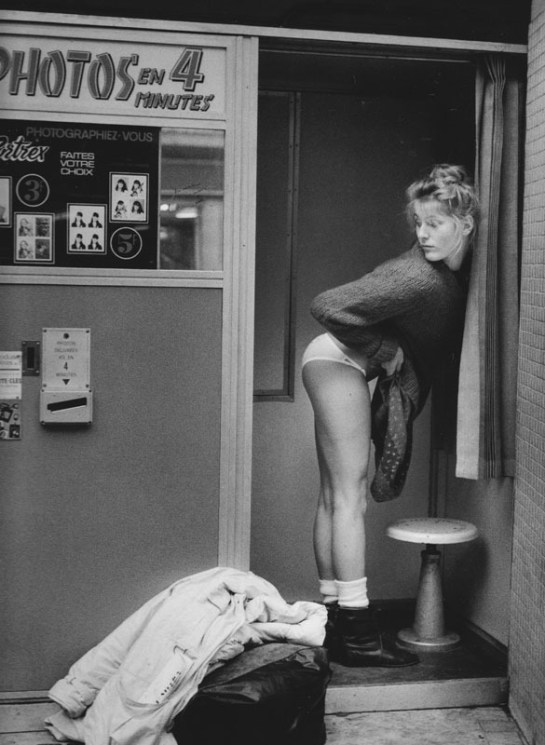
Jean-François Jonvelle (1943–2002) was a French photographer often touted as a master of the erotic image. The link I have added to his name, above, shows a selection of his other work. It is a Google translation of the page, which I hope has worked!

Despite the lass exposing her knickers, I love this, and any other photo that shows, similtaneously, the outside and inside of a now virtually extinct type of photobooth. The prices shown are all in the defunct currency of French francs. This machine offered a choice of options in rare square format prints. But hey, none of you care about any of that. You are too busy looking at the gorgeous woman’s behind, are you not?

What more can I say except bless him for having used a photobooth for one of his shoots, and for not having made it too saucy for this blog.


photoboothYoYoBillAlcott07

From my collection

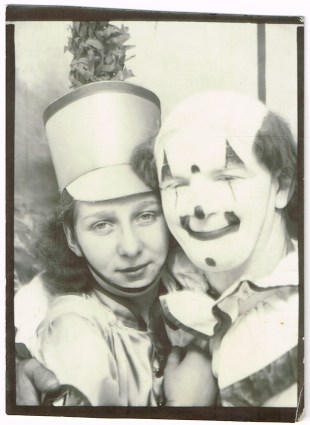
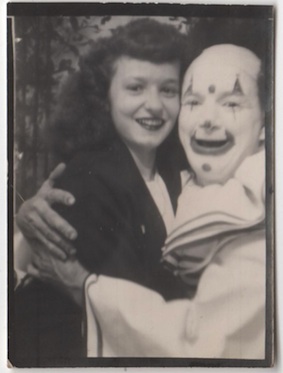
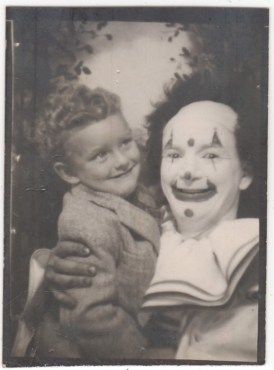
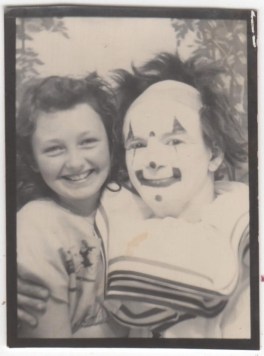
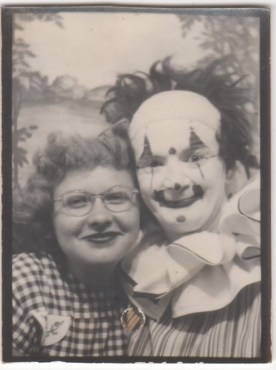
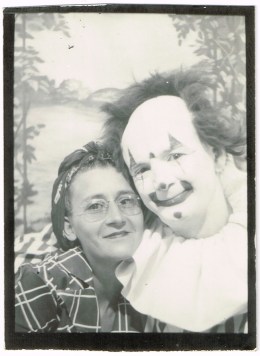
Yo Yo (Bill Alcott) is seen above with a Majorette, which I have just discovered is an American term for a baton twirling marching girl. In Australia we have a different name for this type of performer. We call them  Baton Twirling Marching Girls. Not much linguistic creativity there, Oz! The above souvenir photo is one of many I have seen on eBay, in the past two years or so, where we see Yo Yo posing with a visitor to the carnival or circus. The above photo is the only one that shows somebody in a costume that indicates they were also performers at the event.

My scanner has failed to capture how wonderful this photo is.  There is a depth to the photo that is not visible here. Our marching girl is beautiful. She looks serene and comfortable getting a hug from my favourite clown. I wonder if they were friends?

Below are more photos of Yo Yo with circus goers. Unless otherwise indicated, I do not own them, but copied them from the eBay listing when they were sold.

photoboothClownAndWomanNotMine04

photoboothClownNot BloggedDidn't win03

photoboothClownNotmine01

PhotoboothClownDon't own02

photoboothYoYoBillAlcott08

From my collection